
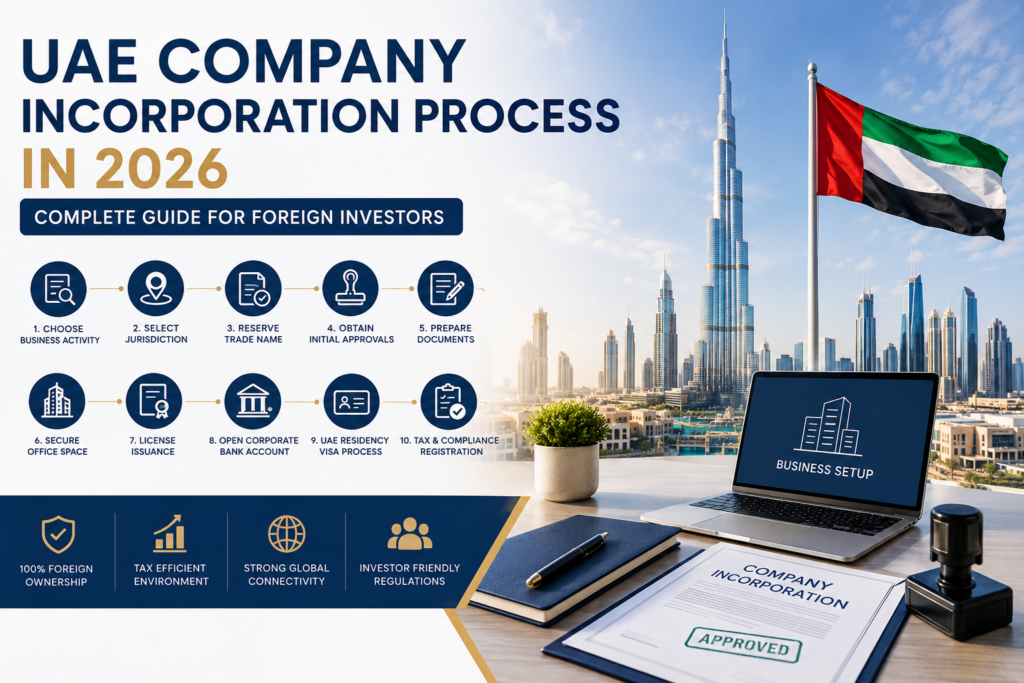
UAE Company Incorporation Process in 2026: Complete Guide for Foreign Investors
UAE company incorporation process planning is essential for businesses that want to avoid banking issues, licensing restrictions, tax complications, and operational delays later.
The UAE continues to attract entrepreneurs, investors, consultants, manufacturers, and international businesses looking for a stable and tax-efficient environment.
Despite the marketing around instant company setup and quick licenses, incorporation in the UAE remains a structured legal and operational process.
A poor setup decision at the beginning creates long-term problems with banking, taxation, licensing, and visas.
This is where many businesses fail.
They choose the cheapest option instead of the correct structure.
Understanding the UAE company incorporation process properly helps businesses avoid expensive restructuring later.
Why businesses choose the UAE
The UAE remains one of the strongest business hubs globally because of:
- Strategic location connecting Asia, Europe, and Africa
- Tax-efficient business environment
- Strong banking infrastructure
- Investor-friendly regulations
- Global trade connectivity
- Residency opportunities
- Political and economic stability
The UAE is especially attractive for:
- Startups
- Trading companies
- Consultants
- Manufacturers
- E-commerce businesses
- International holding companies
Step 1: Identify the correct business activity
The first step in the UAE company incorporation process is selecting the correct business activity.
This sounds simple, but many businesses choose activities that later create operational restrictions or banking problems.
Common activities include:
- Commercial trading
- General trading
- Consultancy
- Manufacturing
- Real estate
- E-commerce
- Media production
- Industrial operations
The business activity affects:
- License type
- Regulatory approvals
- Banking compatibility
- Visa eligibility
- Tax obligations
If the actual business operations do not match the licensed activity, compliance problems follow quickly.
Step 2: Choose mainland or free zone
This is one of the most important decisions in UAE company formation.
Mainland company setup
Mainland companies can operate across the UAE market without geographic restrictions.
Mainland structures are generally suitable for:
- Retail businesses
- Restaurants
- Construction companies
- Professional services
- Manufacturing operations
Mainland advantages include:
- Full UAE market access
- Government contract eligibility
- Wider operational scope
- Local business flexibility
Free zone company setup
Free zones are often ideal for international businesses and specialized industries.
Free zone structures usually suit:
- Consultants
- Digital businesses
- International trading companies
- Holding companies
- Technology startups
Advantages include:
- Faster incorporation
- Simplified setup process
- Industry-focused ecosystems
- Lower entry costs in many cases
- 100% foreign ownership
The best structure depends entirely on operational goals.
Many low-cost free zone setups later become expensive restructuring projects because businesses realize they cannot legally perform required activities.
Step 3: Reserve trade name
The UAE has strict naming guidelines.
The company trade name:
- Cannot violate religious or public standards
- Cannot duplicate existing businesses
- Must align with business activity
- Must follow UAE naming rules
Using international brand references or personal names may require additional approvals.
Step 4: Initial approvals
Once the activity and trade name are approved, authorities issue initial approvals.
These approvals confirm:
- The business activity is acceptable
- The UAE government has no objection
- The shareholders may proceed with incorporation
Certain industries require external authority approvals, including:
- Healthcare
- Education
- Financial services
- Food manufacturing
- Legal consultancy
Missing approvals can significantly delay incorporation.
Step 5: Draft legal documents
The next stage involves preparing legal incorporation documents.
These may include:
- Memorandum of Association
- Shareholder agreements
- Board resolutions
- UBO declarations
- Corporate structure documentation
Poor legal drafting creates long-term shareholder and operational risks.
Step 6: Office space requirements
Most UAE companies require a registered office address.
The requirements depend on:
- License type
- Jurisdiction
- Business activity
- Visa allocation requirements
Some companies use flexi-desks, while industrial businesses may require warehouses or larger facilities.
Choosing office space based only on cost often creates operational limitations later.
Step 7: License issuance
After approvals and documentation are completed, authorities issue the trade license.
The trade license confirms:
- Company name
- Business activity
- Jurisdiction
- Legal structure
- License validity
At this point, the company legally exists, but operational readiness is still incomplete.
Step 8: Corporate bank account opening
Banking is now one of the most difficult parts of the UAE company incorporation process.
Banks require:
- Clear business models
- Operational proof
- Source of funds verification
- Compliance documentation
- Shareholder background checks
Many businesses secure licenses but struggle with banking because the original setup structure was poorly planned.
Banks often reject companies that:
- Lack operational clarity
- Use inconsistent documentation
- Show weak commercial substance
- Operate in high-risk categories
Step 9: UAE residency visa processing
Company owners may apply for UAE residency visas after incorporation.
The process includes:
- Entry permit issuance
- Medical testing
- Emirates ID registration
- Visa stamping
The number of visas depends on:
- Office size
- License category
- Jurisdiction rules
Residency visas also support:
- Bank account opening
- Leasing
- Utilities setup
- Long-term UAE presence
Step 10: Corporate tax and compliance registration
The UAE now operates under corporate tax and compliance regulations.
Businesses may require:
- Corporate tax registration
- VAT registration
- Accounting systems
- AML compliance
- Economic substance compliance
- UBO filings
Ignoring compliance obligations creates serious operational and legal risks.
Common incorporation mistakes
Choosing based only on price
This is one of the most common UAE company formation mistakes.
Cheap setups often lead to:
- Banking failures
- Operational restrictions
- Visa limitations
- Tax complications
- License mismatches
Using incorrect business activities
Improper activity selection creates:
- Compliance problems
- Banking rejection
- Operational restrictions
Ignoring tax planning
Corporate tax changes mean businesses must think long-term about:
- Tax exposure
- Reporting obligations
- International compliance
Weak shareholder agreements
Many partnerships fail because legal agreements were poorly drafted during incorporation.
How long does UAE incorporation take
Typical incorporation timelines include:
- Free zone setup: 3–10 working days
- Mainland setup: 1–4 weeks
- Regulated activities: longer depending on approvals
Banking timelines are separate and often take additional weeks.
Final thoughts
The UAE remains one of the strongest jurisdictions globally for business incorporation.
But successful incorporation is not about getting a trade license quickly.
It is about:
- Choosing the correct structure
- Aligning with banking requirements
- Planning for taxation
- Ensuring legal compliance
- Building long-term operational flexibility
The businesses that succeed in the UAE treat incorporation as strategic infrastructure, not paperwork.
Work with Klay Consultants
Klay Consultants supports entrepreneurs, investors, and international businesses with incorporation, banking support, residency, tax alignment, and long-term UAE business structuring.