
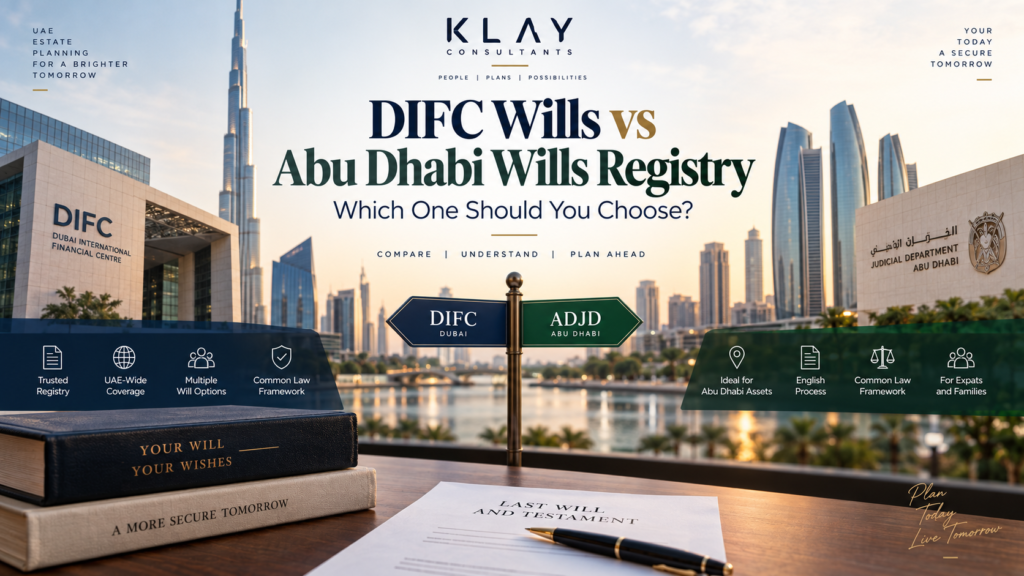
Compare DIFC Wills and Abu Dhabi Wills Registry for coverage, process, costs and suitability for UK, US and GCC expats with UAE assets.
DIFC Wills vs Abu Dhabi Wills Registry: Which One Should You Choose?
Once you decide to register a will in the UAE, one of the most common questions is which registry you should use.
For non-Muslim expats, two established options are the DIFC Wills Service Centre and the Abu Dhabi Judicial Department (ADJD) Wills Registry.
Understanding the difference between DIFC wills vs Abu Dhabi wills can help you identify which option may be more suitable for your assets, family circumstances and location.
Although both options can provide a framework for non-Muslims to document their wishes, they differ in areas such as registration process, jurisdiction, will options and practical considerations.
Why Does the Choice of UAE Will Registry Matter?
Choosing a will registry is an important part of estate planning because the structure and registration process can affect how your wishes are implemented after your death.
Both DIFC and ADJD provide mechanisms for non-Muslims to register wills covering relevant UAE assets.
However, the most suitable option can depend on factors such as:
-
Where you live in the UAE
-
Where your property is located
-
Whether you own a UAE business
-
Whether you have minor children
-
The type of will you require
-
Your preferred registration process
-
Current registration fees
Rather than choosing a registry simply because it is familiar, it is useful to compare the available options based on your individual circumstances.
DIFC Wills Service Centre: Overview
The DIFC Wills Service Centre is part of the Dubai International Financial Centre and provides will-registration services for eligible non-Muslims.
It is widely known among international residents in Dubai and is commonly considered by expats who want to make formal arrangements for their UAE assets.
DIFC wills can address different categories of assets and personal arrangements, depending on the type of will and the applicable rules.
Key Features of DIFC Wills
Some features commonly associated with DIFC wills include:
-
Options for dealing with UAE-based assets
-
An English-language process
-
A common-law-based framework
-
Different will options designed around different estate-planning requirements
-
Options that can address property, financial assets and business interests
-
Guardianship arrangements for eligible families
-
A formal registration and signing process
DIFC offers different will structures depending on what you need to cover.
For example, an individual may require a comprehensive will covering their estate, while a business owner may require arrangements specifically addressing business interests.
Abu Dhabi Judicial Department Wills Registry
The Abu Dhabi Judicial Department (ADJD) also provides a wills-registration route for eligible non-Muslim individuals.
It can be particularly relevant to expats who live in Abu Dhabi or have significant assets registered in the emirate.
Like DIFC, the ADJD framework allows eligible individuals to formally document their wishes regarding their estate.
Key Features of ADJD Wills
Depending on your circumstances and the current rules, key considerations can include:
-
Coverage for relevant UAE assets
-
Particular relevance for Abu Dhabi-based residents and assets
-
English-language documentation and procedures
-
A formal registration process
-
Estate-planning arrangements for eligible non-Muslims
-
Options for addressing property and other assets
Because registration requirements and fees can change, applicants should confirm the current requirements directly or through qualified professional advisers before registering.
DIFC Wills vs Abu Dhabi Wills: Side-by-Side Comparison
| Factor | DIFC Wills | Abu Dhabi Wills Registry |
|---|---|---|
| Main jurisdiction | Dubai International Financial Centre | Abu Dhabi Judicial Department |
| Target users | Eligible non-Muslim individuals | Eligible non-Muslim individuals |
| Language | English | English |
| Legal framework | Common-law-based framework | Common-law-based framework for eligible non-Muslim wills |
| UAE asset coverage | Depending on the will and applicable rules | Depending on the will and applicable rules |
| Property planning | Available subject to applicable requirements | Available subject to applicable requirements |
| Business interests | Options available | Options available subject to applicable requirements |
| Guardianship | Available through relevant arrangements | Available through relevant arrangements |
| Registration | Formal registration process | Formal registration process |
| Fees | Check current fee schedule | Check current fee schedule |
The table provides a general comparison. The precise legal effect and current requirements should always be confirmed for your individual circumstances.
Does It Matter Where You Live?
One of the common questions surrounding DIFC wills vs Abu Dhabi wills is whether you must choose a registry based on your place of residence.
For many eligible non-Muslim expats, the decision is not simply about living in Dubai versus Abu Dhabi.
The location of your assets, your family circumstances and the type of will you need can also be relevant.
For example, someone living in Dubai may own property in Abu Dhabi, while an Abu Dhabi resident may have investments or other assets elsewhere in the UAE.
This is why it is important to consider your complete UAE asset profile before deciding which registration route is appropriate.
What If You Live in Dubai but Own Abu Dhabi Property?
This is a common situation for UAE expats.
A person may live in Dubai but own an investment property in Abu Dhabi, or live in Abu Dhabi while owning assets elsewhere in the UAE.
The question is therefore not simply where you live.
The relevant legal rules and the scope of your registered will should be reviewed carefully to ensure that the assets you want to address are appropriately covered.
A professional adviser can help you determine which structure is suitable for your circumstances.
What About Expats Living in Sharjah, Ajman or Other Emirates?
Expats living outside Dubai and Abu Dhabi may also need to consider their available will-registration options.
The decision can depend on their assets, family circumstances and the applicable requirements of each registry.
For someone living in Sharjah, for example, the most important consideration may be whether they own property, bank accounts or business interests in other parts of the UAE.
Instead of assuming that your residential emirate determines the correct registry, consider the complete picture before making a decision.
How to Register a UAE Will
While the exact process can vary between registries, the general process may involve several stages.
1. Identify Your UAE Assets
Prepare a list of the assets you want your will to address.
This may include:
-
Property
-
Bank accounts
-
Investments
-
Company shares
-
Other UAE-based assets
2. Consider Your Family Circumstances
Think about who should inherit your assets and whether you need to address guardianship arrangements for minor children.
3. Choose the Appropriate Will Structure
Different will options may be available depending on your requirements.
A full estate will, property-related will, business-related will or guardianship arrangement may each address different needs.
4. Prepare the Will
The document should be prepared carefully so that your wishes are clearly expressed and the relevant requirements are satisfied.
5. Complete Registration
Follow the chosen registry’s current registration process, including identification, appointment and signing requirements.
6. Keep Your Details Updated
Your circumstances can change.
If you purchase new property, start a company, have children or experience another major life change, review whether your existing estate plan still reflects your wishes.
Common Mistakes When Choosing a Will Registry
When comparing DIFC wills vs Abu Dhabi wills, expats sometimes make avoidable mistakes.
Assuming One Registry Only Covers One Emirate
The scope of a will should be checked carefully rather than assuming that it only applies to assets in the emirate where it was registered.
Ignoring Current Fees
Registration fees and related charges can change.
Always check the current fee structure before making your decision.
Choosing Based Only on Location
Your place of residence is relevant, but it should not necessarily be the only factor.
Your property, business interests, family and estate-planning objectives should also be considered.
Delaying the Decision
Some people spend months comparing options and never actually register a will.
If estate planning is important to you, obtaining appropriate advice and completing the process can be more useful than leaving your assets subject to uncertainty.
Forgetting to Tell Your Executor
Your chosen executor should know that a will exists and understand where the relevant documentation and registration details are kept.
Frequently Asked Questions
Is DIFC Wills Service Centre better than Abu Dhabi Wills Registry?
There is no single option that is suitable for every individual. The appropriate registry can depend on your residence, assets, family circumstances and estate-planning requirements.
Can a DIFC will cover property in Abu Dhabi?
The scope of coverage should be confirmed based on the current DIFC rules and the specific will being registered. If you own property in Abu Dhabi, discuss the asset with your legal adviser before registration.
Can I register a will with both DIFC and ADJD?
Registering with both is not generally necessary for most individuals, but the correct approach depends on your circumstances. Having multiple wills without careful coordination can also create unnecessary complexity.
Is one registry cheaper?
Fees can change, so a current comparison is necessary. Rather than relying on historical prices, check the latest official fee schedules before registering.
Do I need a lawyer to register a UAE will?
Legal assistance may not always be mandatory, but professional guidance can help ensure that your will properly addresses your assets, beneficiaries and other relevant requirements.
Which UAE will should a UK or US expat choose?
UK and US expats should consider their UAE assets, family circumstances and international estate-planning arrangements before selecting a registry. A professional adviser can help coordinate the UAE will with existing international arrangements.
DIFC Wills vs Abu Dhabi Wills: Making an Informed Choice
When comparing DIFC wills vs Abu Dhabi wills, the decision should be based on your individual circumstances rather than simply choosing the most familiar registry.
Consider where you live, where your assets are located, whether you own a business, whether you have minor children and which estate-planning arrangements you need.
Both DIFC and ADJD provide established routes for eligible non-Muslim individuals to formally document their wishes in the UAE.
Because regulations, fees and registration procedures can change, it is important to obtain up-to-date professional advice before registering your will.
Protect Your UAE Assets and Family
A properly planned UAE will can provide greater clarity about what should happen to your assets and family arrangements in the future.
For UK, US and GCC expats, understanding the available options is an important part of international estate planning.
Klay Consultants works with legal partners to help expats understand their UAE will options and navigate the registration process based on their assets and family circumstances.
If you are unsure whether DIFC or ADJD is appropriate for you, speak with Klay Consultants to discuss your circumstances and understand the available options.