
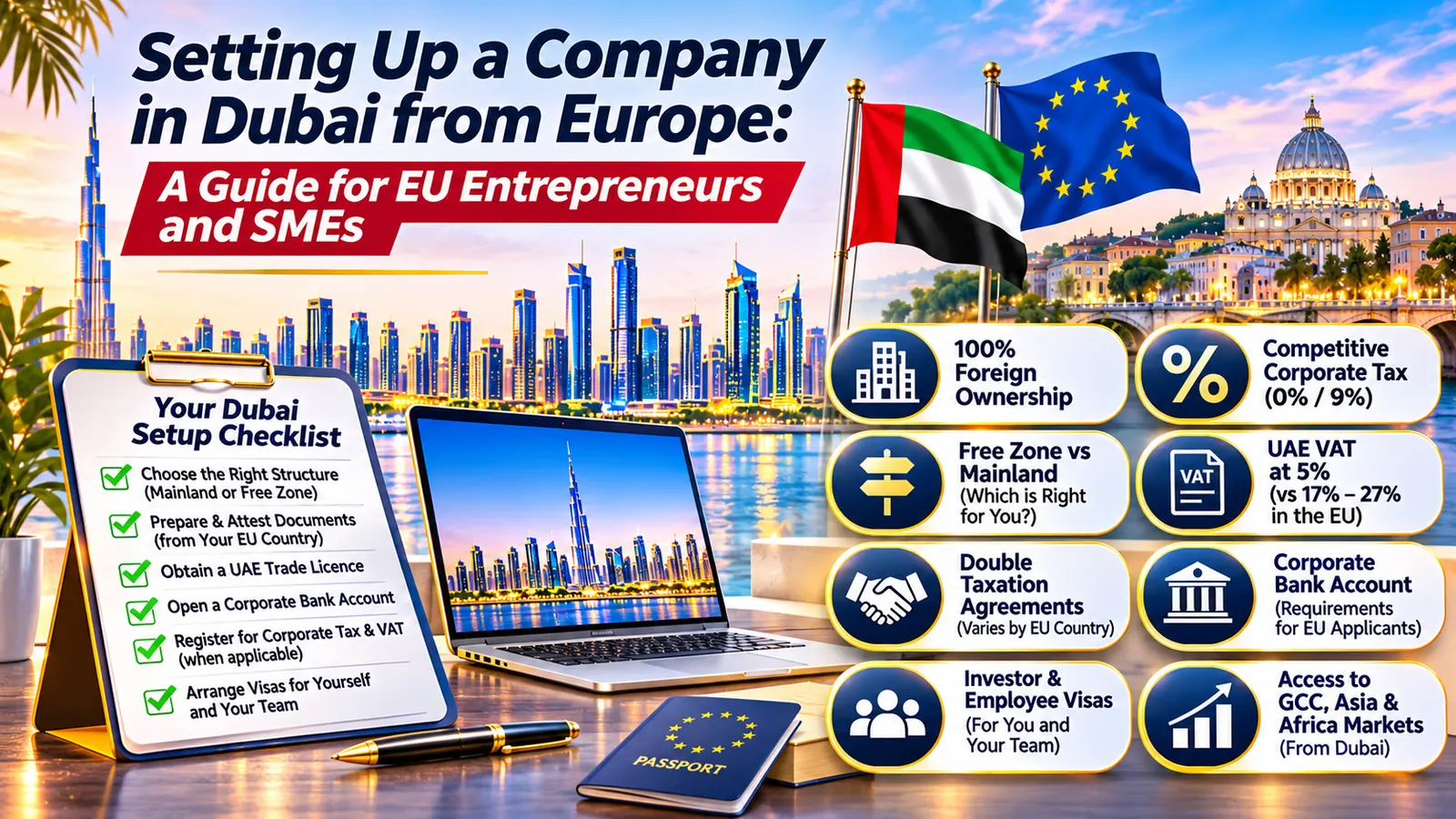
Business Setup in the UAE for European Founders: A Guide for EU Entrepreneurs
European entrepreneurs, from Germany, France, Spain, Italy, the Netherlands and across the continent, are increasingly looking at the UAE as a base for new ventures or as a second market for an existing company. The attractions are familiar: a favourable tax environment, a strategic location, and an entrepreneurial culture. But moving a business or building one from Europe involves issues that matter specifically to EU founders, from tax residency to data protection and documentation.
Why European Founders Look at the UAE
- No personal income tax in the UAE, and a corporate tax regime with relief for smaller businesses
- Easy access to Middle East, Africa and Asia from a central time zone
- Quick company formation and an English-friendly business environment
- A large international community and strong travel connections to Europe
Choosing the Right Structure
As covered in our jurisdiction guides, most European founders choose between a Free Zone company for international and online business and a Mainland company for local customers. If you serve primarily EU customers, a Free Zone structure often suffices, but be aware of the VAT and consumer-law rules that apply when you sell into the EU from outside it.
Tax Residency Is the Key Question
The most important point for EU founders is that forming a UAE company does not automatically change where you are tax resident. If you continue to live in an EU country, or maintain strong ties such as a family home, your home country may continue to treat you as a tax resident and may tax worldwide income, including profits of a foreign company you control under controlled-foreign-company rules. Several European countries also apply exit taxes or special rules when residents move abroad. Take advice from a qualified tax adviser in your home country before restructuring, and consider how time spent in each country is counted.
Double Tax Treaties
The UAE has a broad network of double tax treaties, including with many European countries, which can reduce withholding taxes and clarify which country can tax certain income. Treaty benefits usually depend on you or your company being a tax resident of the UAE and meeting conditions, so substance matters. Check the treaty between the UAE and your country, and see our UK-focused coverage for the principles involved.
Substance and Real Presence
European tax authorities look closely at whether a foreign company has genuine economic substance. If the company is managed and controlled from your home country, tax authorities may argue that it is effectively resident there. To be defensible, a UAE company should have real activity in the UAE, ideally including local management, premises and, where appropriate, staff, as covered in our ESR guide.
EU Consumer, VAT and Data Rules
Selling to EU consumers from the UAE can trigger EU VAT obligations, and you may need to register for VAT schemes in the EU. If you process personal data of EU residents, the EU data protection regulation applies even if your company is based in the UAE. Plan these obligations from the start rather than treating the UAE entity as a way to avoid them.
Documents and Legalisation
Corporate and personal documents from European countries often need notarisation and legalisation. The UAE has joined the Hague Apostille Convention, which should simplify the process for documents issued by member countries, but you should confirm exactly what each authority will accept, as covered in our remote setup guide.
Banking
UAE banks will want to understand your business, your source of funds and your connections to Europe. Having clear documents, business contracts and evidence of income makes a difference, as covered in our banking guides.
Visas and Relocation
If you plan to live in the UAE, you can apply for an investor or partner visa through your company, and for family sponsorship, as covered in our visa guides. If you meet the criteria, the Golden Visa can provide longer-term residency. Plan relocation with your tax adviser, since the timing of your move can affect your tax position.
Step-by-Step Overview
- Clarify your goals: relocate, expand, or serve the Gulf market
- Take home-country tax advice before making structural decisions
- Choose jurisdiction and activity
- Prepare and legalise documents
- Incorporate and open a bank account
- Apply for visas if relocating
- Set up accounting, corporate tax, VAT and compliance
Common Mistakes
- Assuming a UAE company eliminates home-country tax obligations
- Running the company entirely from Europe without UAE substance
- Ignoring EU VAT and data protection rules
- Moving residence without a plan for exit tax and social security
Three Common Scenarios
Scenario 1: The consultant who wants to relocate
A founder moving from Spain to Dubai plans to run a consulting business with European clients. She establishes a Free Zone company, applies for an investor visa, and moves her family. Because she genuinely relocates, spends most of her time in the UAE and ends her ties to her home country in line with local rules, her tax position may change. She still takes advice on exit and social security issues.
Scenario 2: The e-commerce owner who stays in Europe
A founder in the Netherlands opens a UAE company for logistics and Gulf sales while living at home. Because he remains a European tax resident and manages the company from there, his home country may still tax the profits. The UAE entity is useful for regional business but does not remove his obligations.
Scenario 3: The company expanding into the Gulf
A German company opens a UAE branch or subsidiary to serve Gulf customers. Transfer pricing, branch profit allocation and substance become the main concerns, and the company needs a clear plan for management, staffing and bookkeeping in the UAE.
Social Security and Pensions
European founders often overlook social security. Moving abroad can affect pension contributions, healthcare coverage and entitlement to benefits. Some countries have agreements that affect coverage while you work abroad. Check your position and consider private health and pension arrangements for yourself and your family.
Relocate or Manage Remotely?
Relocating makes it easier to build real substance, take advantage of residency and run local operations, but it is a major life decision. Managing remotely from Europe is simpler personally but carries greater tax and substance risk. Some founders adopt a staged approach, starting with a UAE entity and gradually shifting their time and management as the business and family situation allow.
Practical Timeline for a European Founder
- Months 1 to 2: Take tax advice, plan structure and timeline, and gather documents
- Months 2 to 3: Incorporate, open the bank account and set up accounting
- Months 3 to 6: Apply for residency, relocate if planned, and move operations gradually
- Ongoing: Maintain substance, comply with corporate tax and revisit your plan annually
Language, Contracts and Governing Law
If you serve European customers, contracts may be governed by European law and written in local languages. Decide which law and courts apply, as covered in our dispute resolution guide, and ensure your terms comply with consumer and e-commerce rules in the markets you serve.
Frequently Asked Questions
Do I have to move to the UAE to benefit from a UAE company?
Not necessarily to own one, but tax outcomes depend on your residency and where the company is managed, so structure it with proper advice.
Can I keep my EU company and open a UAE one?
Yes, many founders operate both, using the UAE entity for Gulf and international business. Consider transfer pricing and substance.
Is there an EU-UAE free trade agreement?
There is no comprehensive free trade agreement with the EU as a bloc at present, but the UAE has many bilateral and treaty arrangements. Check current developments before relying on trade preferences.
Expanding from Europe? Klay Consultants helps European founders build a UAE structure that works with their home-country tax and compliance position. Book a free consultation.
This article provides general information only and is not legal, tax, immigration or financial advice. UAE licensing, ownership, regulatory and tax requirements vary by emirate, Free Zone, activity and individual circumstances, and can change. Confirm current requirements with the relevant authority or a qualified adviser before acting.