
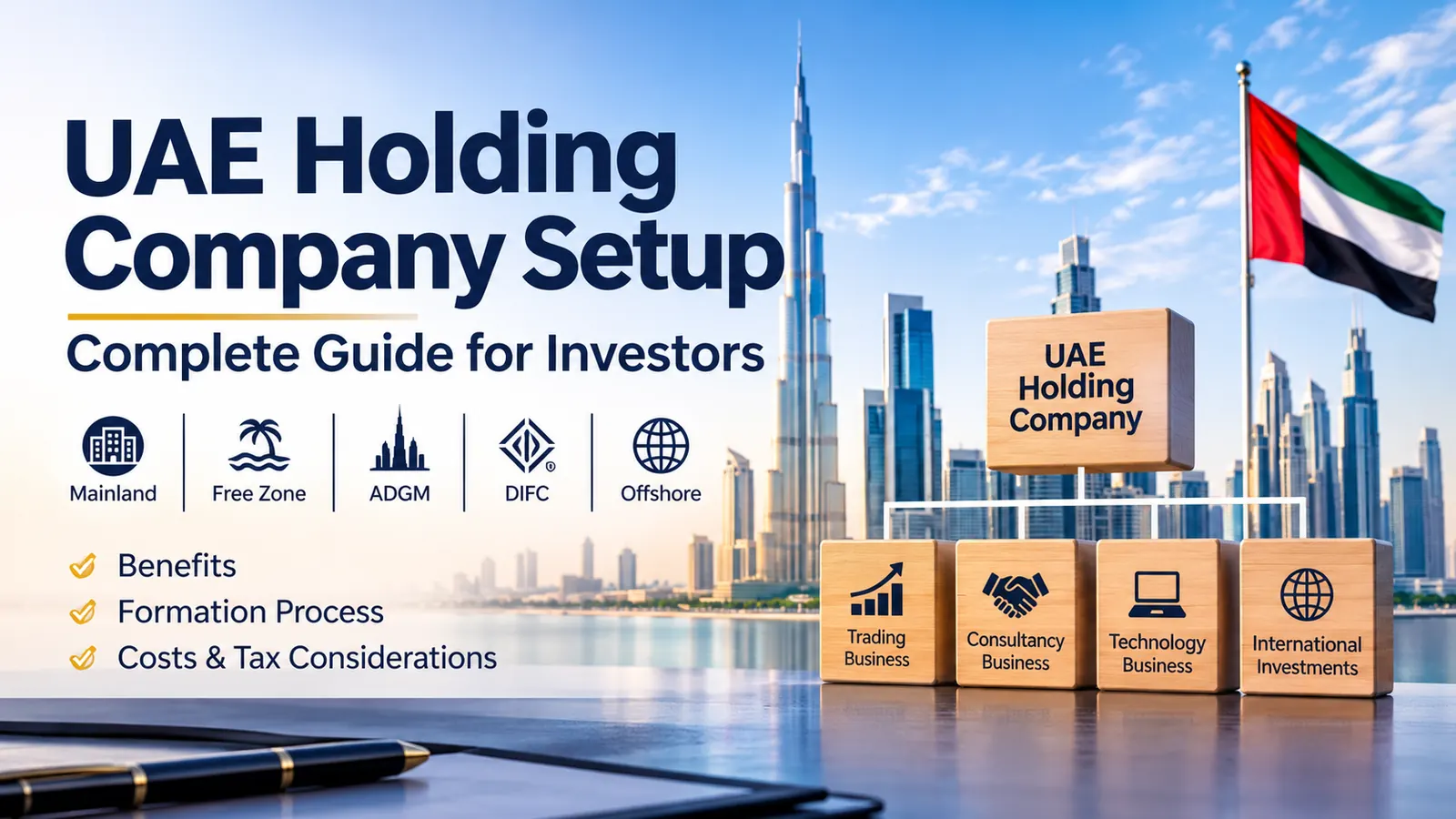
UAE Holding Company Setup: Complete Guide | Klay Consultants
A UAE holding company can be used to hold shares or other assets, organise group ownership, or support investment and succession planning. The appropriate structure depends on what the company will own and do, where its subsidiaries and investors are based, and the legal, regulatory, tax and governance requirements that apply. Mainland, Free Zone, ADGM, DIFC and offshore options are not interchangeable, and no structure guarantees a particular tax result. Define the intended use and obtain qualified legal and tax advice before forming the entity.
What Is a Holding Company?
A holding company primarily owns interests in other companies or assets. Depending on its licence and legal form, it may also provide management or other permitted services to group entities. Its activities must be accurately described and authorised by the chosen licensing or registration authority; the label “holding company” does not by itself permit every type of investment or service.
A holding structure can make ownership and governance clearer, separate some business functions, and provide a platform for investment or group restructuring. The actual legal, commercial, liability and tax effects depend on the entities, contracts, jurisdictions and applicable laws involved. A holding company should not be treated as a guaranteed asset-protection or tax-avoidance device.
Compare UAE Holding Company Jurisdictions
The best jurisdiction depends on the assets to be held, where operating companies are located, the investors’ needs, intended activities, substance and ongoing administration. Compare the authority’s permitted legal forms and activities, ownership rules, premises requirements, annual fees, reporting duties and applicable court and regulatory framework.
Mainland
A Mainland entity may suit a group that needs a UAE onshore company structure or activities licensed by the relevant emirate authority. Confirm the permitted activities, legal form, approvals, ownership requirements and any office or facility conditions with that authority.
Free Zones
Free Zones offer different company forms and activity packages, and some may support holding or investment activities. Each zone has its own rules, fees, reporting and substance expectations. A Free Zone registration does not automatically authorise the entity to conduct every activity or operate in every market.
ADGM and DIFC
ADGM and DIFC are financial free zones with their own company registries and legal and regulatory frameworks. They offer specific structures, which may include special-purpose or prescribed-company options subject to eligibility and permitted-use conditions. Check the current registry rules and whether the proposed assets, ownership and activities qualify.
Offshore Companies
Offshore companies are registered under separate jurisdictional regimes and are generally designed for defined international holding or ownership purposes. Their permitted activities and limitations differ from an onshore or operational UAE company. Confirm whether an offshore entity can hold the intended UAE or foreign assets and what banking, substance, tax and reporting requirements apply.
Holding Company, Offshore Company and SPV
These terms describe different things. A holding company describes the company’s purpose or role; offshore describes a registration regime and its permitted scope; and a special-purpose vehicle (SPV) is typically established for a defined transaction, asset or financing purpose. A particular SPV may function as a holding company, but it is subject to the rules of its registry and cannot be assumed to have broad operating powers.
ADGM SPVs and DIFC Prescribed Companies are governed by different frameworks and eligibility conditions. Compare qualifying purposes, eligible applicants, activities, registered-office arrangements, annual filings and costs using current registry guidance before choosing between them.
How to Set Up a Holding Company in the UAE
The formation process varies by authority and legal form. Prepare a group structure and identify the assets or shares the company will hold before applying. This helps the authority and professional advisers assess the activity, ownership, constitutional documents and any approvals required.
- Define the business purpose, proposed assets, subsidiaries and intended transactions.
- Compare eligible jurisdictions, legal forms, activities and ongoing obligations.
- Confirm shareholder, director, beneficial-owner and substance requirements.
- Select and reserve an available company name and prepare incorporation documents.
- Submit the application, supporting identity and corporate records, and any required approvals.
- Complete licensing or registration, premises or registered-office arrangements, and applicable fees.
- Set up accounting, governance, tax registrations and records before beginning activity.
Documents and Ongoing Requirements
Authorities commonly request identity and address records for owners and directors, ownership and beneficial-owner information, constitutional documents, and details of the proposed activities and assets. Where an existing company is a shareholder, the registry may request parent-company records, resolutions, signatory evidence and authenticated documents. Exact requirements, attestations and translations depend on the jurisdiction and origin of the records.
After formation, maintain the company’s licence or registration, statutory registers, accounting records, resolutions, annual filings and any required registered-office or substance arrangements. Keep ownership and control information current, and obtain approval before undertaking activities outside the registered scope.
UAE Corporate Tax and Holding Companies
A holding company should not assume that dividends, share disposals or other investment income are automatically exempt from UAE Corporate Tax. The treatment depends on the applicable law and conditions, the nature of the income, ownership and holding-period criteria where relevant, and the company’s circumstances. Free Zone status alone does not guarantee a 0% result for every income stream.
Assess Corporate Tax registration, filing, recordkeeping, related-party and transfer-pricing requirements with a qualified tax adviser. Consider whether a participation exemption or other treatment may apply only after checking all statutory conditions and documentation requirements. Tax rules and administrative guidance can change, so obtain advice based on the proposed structure and current rules.
Formation Costs and Annual Budget
There is no single UAE-wide cost for a holding company. Fees depend on the chosen authority and legal form, activities, shareholder structure, registered office or premises, professional services and ongoing filings. Request a written, itemised quotation that distinguishes one-time incorporation costs, government charges and recurring annual costs.
- Name reservation, incorporation, registration and licence or renewal charges.
- Registered-office, facility, agent or other jurisdiction-specific requirements.
- Document notarisation, legalisation, translation and corporate attestations.
- Legal, accounting, tax, audit and company-secretarial support.
- Banking, transaction, filing and compliance administration.
- Costs of transferring or registering shares and other assets, where applicable.
Can a UAE Holding Company Own Foreign Companies?
A UAE company may be able to hold shares in foreign entities, subject to its licensed activities, the rules of its UAE registry, the law of each subsidiary’s jurisdiction, and any sector-specific or investment restrictions. Before acquiring shares, confirm that both the UAE company and the target jurisdiction permit the proposed ownership and that all required approvals and filings can be completed.
Review the cross-border legal, tax, reporting, banking and governance implications of the entire group. If the structure is intended for succession or estate planning, coordinate company documents with independent legal and tax advice in each relevant jurisdiction.
Choose a Structure Based on the Group’s Needs
Compare the available options against the intended assets and transactions, investor requirements, access to banking, costs, reporting, substance, tax treatment and future exit plans. Ask the relevant authority or qualified adviser to confirm eligibility and permitted activities in writing. A careful design before incorporation can help avoid an entity that is unable to hold the planned asset or undertake the intended transaction.
Frequently Asked Questions
Can foreigners establish a holding company in the UAE?
Foreign ownership may be available depending on the selected jurisdiction, legal form, activity and applicable rules. Confirm current eligibility and documentation with the authority before applying.
Which jurisdiction is best for a UAE holding company?
There is no universally best jurisdiction. Compare Mainland, Free Zone, ADGM, DIFC and offshore options against the intended assets, transactions, ownership, regulatory framework, costs and ongoing obligations.
Is an offshore company the same as a holding company?
No. “Holding company” describes a purpose or role, while “offshore” describes a registration regime with its own permitted activities and restrictions. An offshore company may be used for holding purposes only where its rules allow.
Are holding companies exempt from UAE Corporate Tax?
Not automatically. Tax treatment depends on the applicable law, income, ownership and other conditions. A qualified tax adviser should assess the specific structure and required evidence.
Can a UAE holding company own foreign companies?
It may be possible, subject to the UAE entity’s permitted activities and the laws, approvals and reporting requirements in each relevant jurisdiction. Confirm both sides of the proposed investment before proceeding.
How much does a UAE holding company cost?
Costs vary by jurisdiction, legal form, activity, office requirements, documents and ongoing compliance. Obtain an itemised quotation based on the proposed structure rather than relying on a generic package price.
What is the difference between an ADGM SPV and a DIFC Prescribed Company?
They are distinct structures under separate registry frameworks, each with its own purposes, eligibility conditions, permitted activities and filing requirements. Compare current official rules and get advice based on the proposed ownership and assets.
Planning a UAE holding structure for investments or a group of companies? Klay Consultants can help you compare formation routes and prepare for the incorporation process. Confirm legal, regulatory and Corporate Tax implications with qualified advisers before transferring assets or establishing the structure. Book a free consultation.
This article is for general information only and is not legal, tax, investment or financial advice. Jurisdiction rules, fees, permitted activities and tax treatment depend on the specific company and circumstances and may change. No tax exemption, asset-protection outcome, banking result or investment return is guaranteed. Confirm current requirements with the relevant authorities and qualified independent advisers.