
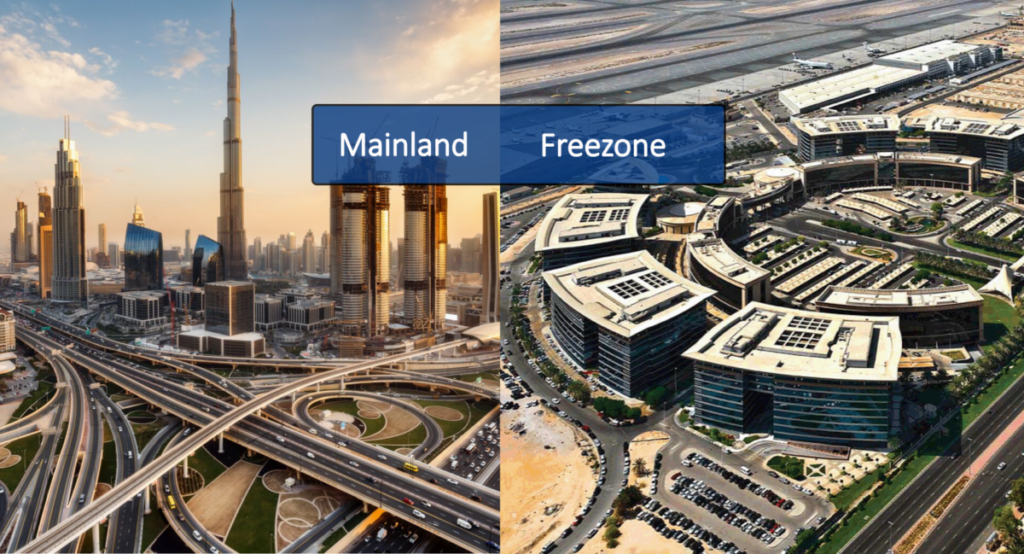
Free Zone vs Mainland UAE Company Setup: Which One Is Actually Right for Your Business?
Free zone vs mainland UAE company setup decisions affect banking, taxation, operational flexibility, investor credibility, visa eligibility, and long-term business scalability.
One of the biggest mistakes entrepreneurs make in the UAE is choosing a business setup structure based on price instead of operational strategy.
That decision usually becomes expensive later.
A company structure affects:
- Banking access
- Tax exposure
- Visa eligibility
- Operational freedom
- Investor credibility
- Future scalability
Yet many businesses still choose setups based on social media marketing promising:
- Cheapest UAE license
- Instant company formation
- Lifetime visa package
That marketing creates problems because the cheapest structure is rarely the correct structure.
Understanding the difference
The UAE broadly offers two major setup routes:
- Mainland companies
- Free zone companies
Both are legitimate structures.
Both have advantages.
Neither is universally better.
The right structure depends entirely on business objectives.
What is a mainland company?
A mainland company is licensed by UAE mainland authorities and can generally operate across the UAE without major geographic restrictions.
Mainland companies can:
- Trade directly within the UAE
- Serve local markets
- Bid for government contracts
- Operate physical retail locations
- Expand across emirates
This makes mainland structures ideal for businesses requiring strong UAE market integration.
What is a free zone company?
Free zones are specialized economic jurisdictions designed to encourage foreign investment.
Free zone companies often benefit from:
- Simplified incorporation
- Faster licensing
- Lower startup costs
- Industry-focused ecosystems
Many international businesses use free zones effectively for:
- Consulting
- E-commerce
- Technology
- Media businesses
- Holding structures
- International trade
When mainland makes more sense
You need UAE market access
If your business serves UAE customers directly, mainland setup is often the more practical option.
You need government contracts
Many public-sector opportunities require mainland licensing structures.
You operate physical retail
Retail stores, restaurants, and physical service businesses generally require mainland licensing.
You need operational flexibility
Mainland companies usually face fewer operational restrictions within the UAE.
When free zone makes more sense
International operations
Free zones work well for businesses focused on international trade or remote service operations.
Lower initial costs
Some free zones provide lower startup barriers for entrepreneurs.
Digital businesses
Consultants, agencies, creators, and software companies often prefer free zone structures.
Holding structures
Free zones are frequently used for regional ownership and investment structures.
Banking differences
This is where many businesses get surprised.
Banks do not approve companies based only on whether they are mainland or free zone.
Banks evaluate:
- Business activity
- Commercial substance
- Ownership clarity
- Financial legitimacy
- Compliance exposure
However, certain low-cost free zone setups have developed weaker reputations with banks because they are associated with non-operational businesses.
That does not mean free zones are bad.
It means weak structures create weak credibility.
Corporate tax considerations
The UAE now operates under corporate tax regulations.
This significantly changed the setup landscape.
Businesses must now consider:
- Tax residency
- Qualifying income
- Free zone compliance
- Transfer pricing
- Accounting obligations
Tax planning should happen before incorporation, not after problems appear.
Visa considerations
Both mainland and free zone companies can provide UAE residency visas.
However:
- Visa allocation rules differ
- Office requirements differ
- Regulatory expectations differ
Businesses planning to scale teams must structure carefully.
Operational limitations
Some free zone companies face restrictions when dealing directly within mainland UAE markets.
This is one of the most misunderstood business setup issues online.
Many entrepreneurs discover operational limitations only after incorporation.
The real cost problem
Cheap setup packages usually ignore:
- Banking support
- Compliance structuring
- Tax planning
- Long-term scalability
- Operational suitability
Businesses later spend significantly more correcting poor structures.
A cheap setup that blocks banking access is not cheap.
It is expensive failure delayed by a few months.
Questions businesses should ask before choosing
- Where are your customers located?
- Will you hire employees?
- Do you need warehousing?
- Will you operate physical retail?
- Will you seek investors?
- Is international trade involved?
- What are your banking requirements?
- What is your long-term expansion strategy?
Without answering these questions properly, choosing a structure becomes guesswork.
Common mistakes
Choosing based only on setup cost
This remains the most common failure point.
Ignoring banking requirements
A company without banking access is operationally restricted.
Wrong activity selection
Improper licensing creates compliance and operational problems later.
No tax planning
Corporate tax changes now make structuring decisions significantly more important.
Final thoughts
There is no universally perfect UAE setup structure.
There is only:
- The correct structure for your business
- And the wrong one
Businesses that treat incorporation strategically usually scale faster and face fewer operational issues.
Businesses chasing shortcuts usually restructure later at significantly higher cost.
Work with Klay Consultants
Klay Consultants helps entrepreneurs, investors, and international businesses choose and establish the correct UAE structure based on operational goals, compliance needs, banking compatibility, and long-term scalability.