
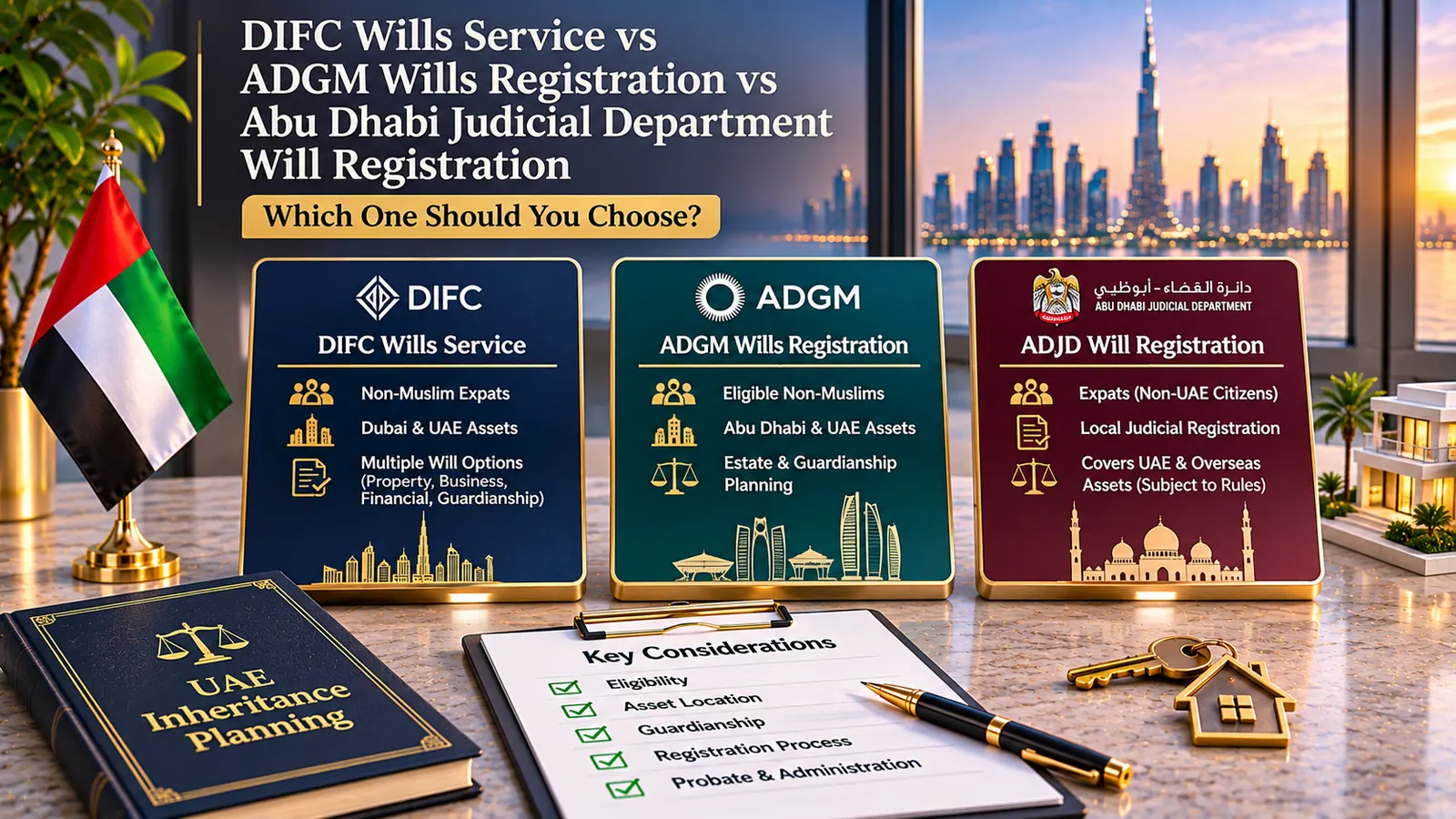
DIFC Wills Service vs ADGM Wills Registration vs Abu Dhabi Judicial Department Will Registration: Which One Should You Choose?
Choosing the right will-registration route in the UAE can feel confusing. The DIFC Wills Service, ADGM Wills Registration and Abu Dhabi Judicial Department (ADJD) Will Registration operate through different legal and administrative frameworks. Their eligibility conditions, documentation requirements, registration procedures and post-registration processes may differ. Your religion and eligibility, asset locations, family arrangements, asset types and preferred legal framework all matter. This guide compares the three routes and highlights questions to discuss with a qualified UAE succession lawyer.
Why Expats Need a UAE-Specific Will Strategy
A will prepared in another country may not automatically provide a straightforward route for dealing with property, bank accounts, company shares or other assets held in the UAE. Recognition, translation, authentication and local procedures may need to be considered.
A UAE-specific will strategy can help communicate wishes about UAE-based assets, appoint executors, address guardianship arrangements where permitted, plan for company shares and coordinate UAE assets with overseas arrangements. A registered will is important, but it does not automatically resolve issues involving jointly owned assets, company ownership, overseas property or succession procedures.
- Distribution of UAE-based property and financial assets.
- Appointment of executors to administer the estate.
- Guardianship arrangements for minor children, where applicable.
- Succession of company shares and business interests.
- Coordination between UAE assets and overseas assets.
Understanding the Three UAE Will Registration Options
1. DIFC Wills Service
The DIFC Courts Wills Service provides a registration framework for eligible non-Muslims who want to record instructions for the distribution of UAE assets and, where applicable, the appointment of guardians for minor children. The service is administered through the DIFC Courts Wills and Probate Registry.
DIFC Courts list categories including Full, Guardianship, Property, Business Owners, Financial Assets and Digital Assets Wills. Each type has its own scope and conditions. For example, the published descriptions include limits for the Property Will, Business Owners Will and Financial Assets Will. Check the current registry rules before selecting a type.
The published eligibility information states that an applicant must be non-Muslim, at least 18 years old, and own qualifying UAE assets and/or have minor children residing with them in the UAE. The DIFC Courts state that UAE residency is not required for an eligible person. Guardianship provisions have additional requirements, including rules that can depend on where children reside.
- May suit eligible non-Muslims who want to consider its dedicated will categories.
- Can address specified UAE assets depending on the will type and registry rules.
- Guardianship options are subject to applicable eligibility and residence conditions.
2. ADGM Wills Registration
The ADGM Courts Notary Public and Wills Office provides a route for notarising non-Muslim wills within Abu Dhabi’s legal and judicial framework. Its templates address estate disposition, guardianship of minor children, or both.
ADGM’s published guidance describes eligibility for non-Muslim individuals aged 21 or older who own UAE assets. The required will and supporting documents should be prepared carefully. Official guidance specifies a bilingual Arabic and English document certified by a UAE Ministry of Justice-licensed legal translator.
ADGM guidance states that its Notary Public can notarise wills relating to assets in the UAE, including outside Abu Dhabi, and assets outside the UAE. Probate for overseas assets must be obtained in the jurisdiction where those assets are located. ADGM’s Notary Public and Wills Office does not itself provide probate; applications must be submitted through the relevant ADJD Wills and Probate Office.
- May suit eligible individuals who want to use ADGM’s wills notarisation framework.
- Document translation and appointment requirements should be confirmed before applying.
- Understand the separate probate route and how it relates to the location of assets.
3. Abu Dhabi Judicial Department Will Registration
ADJD provides a will-registration route through its civil wills and judicial services. Its published information states that non-UAE citizens may register a civil will regardless of religion; do not assume that the same eligibility applies to DIFC or ADGM.
The general process may include submitting an application and documents, departmental review, payment of the applicable fee, booking an appointment and completing certification or notarisation subject to approval. ADJD publishes forms in Arabic and English and states in its FAQ that funds and property outside the UAE may be included. Overseas assets may still require local recognition or probate in the country where they are held.
ADJD service information has listed regular and special will registration fees. Fees and conditions can change, so confirm the current schedule directly with the department before applying.
- May suit people who prefer the Abu Dhabi civil wills registration route.
- Confirm current eligibility, document and application requirements with ADJD.
- Consider how the relevant judicial and probate process applies to your estate.
DIFC vs ADGM vs ADJD: Key Differences
This is a high-level comparison, not a substitute for checking current rules against your circumstances. Published requirements, fees and procedures may change.
| Comparison | DIFC Wills Service | ADGM Wills Registration | Abu Dhabi Judicial Department |
|---|---|---|---|
| Main authority | DIFC Courts Wills and Probate Registry | ADGM Courts Notary Public and Wills Office | Abu Dhabi Judicial Department |
| Published eligibility | Non-Muslim, 18+, qualifying UAE assets and/or qualifying minor children | Non-Muslim, 21+ and UAE assets, according to published guidance | Civil wills route; published information states non-UAE citizens may register regardless of religion |
| Will options | Full, Guardianship, Property, Business Owners, Financial Assets and Digital Assets | Estate disposition, guardianship, or both | Civil will registration through ADJD |
| Language and documents | Requirements depend on will type and registry rules | Bilingual Arabic and English will certified by a UAE-licensed legal translator, according to guidance | Arabic and English forms; additional translation or authentication may be required |
| Assets | UAE asset categories depend on will type and rules | Guidance allows UAE and overseas assets; overseas probate remains local | FAQ states that overseas funds and property may be included |
| Guardianship | Specific provisions subject to registry rules | Guardianship-only and combined options are available subject to rules | Check the applicable civil wills process |
| Probate | DIFC Courts Wills and Probate Registry handles matters under its framework | ADGM Notary Public and Wills Office does not provide probate; applications go to the relevant ADJD office | Handled through the relevant ADJD process |
Eligibility: Which Will Registration Route Can You Use?
Eligibility is one of the first things to confirm. A service may appear suitable based on assets or location but have specific requirements relating to religion, age, residency or will type. Confirm the latest official criteria before preparing documents or paying fees.
DIFC Eligibility
The DIFC Courts’ published FAQ states that an applicant must be non-Muslim and must never have been Muslim, be at least 18 years old, and own UAE assets and/or have minor children residing with them in the UAE. The courts also state that UAE residency is not required for an eligible person. Guardianship provisions have additional requirements, including distinctions based on where the children reside.
ADGM Eligibility
ADGM’s published wills guidance describes the service as available to non-Muslim individuals aged 21 or older who own UAE assets. Review the official requirements before preparing the will, including required personal and beneficiary details, executor appointments and estate distribution instructions.
ADJD Eligibility
ADJD provides a civil wills registration route. Its published information states that non-UAE citizens may register a will regardless of religion. This is a material distinction, but it does not mean all three services have the same eligibility rules or legal effects.
Will Registration Process: What Should You Expect?
Each service has its own procedures, but preparing a will generally involves the following planning stages:
- Identify assets and liabilities, including property, bank accounts, investments, company shares, insurance, digital assets and overseas holdings. Record each asset’s location, legal owner and supporting documents.
- Decide who should receive assets and consider dependants, alternative beneficiaries and clear distribution instructions.
- Choose an executor who is willing and able to manage practical responsibilities, and consider a substitute executor.
- Consider guardianship for minor children separately from asset distribution. Check the chosen route’s rules and do not assume a nomination guarantees an appointment in every circumstance.
- Compare eligibility, asset locations, will types, legal framework, fees, translation requirements and probate arrangements.
- Prepare and review the document against registry requirements, company documents and existing estate-planning arrangements.
- Submit the application and complete the selected authority’s current document, payment, translation, identity verification and appointment requirements.
- Keep the registered will and supporting records accessible, and review the plan after major family, asset, business or residence changes.
Which Option May Suit Your Assets and Circumstances?
Dubai-Based Assets
DIFC may be one option to investigate for eligible non-Muslims with Dubai assets who want to consider its dedicated will types and wills and probate framework. Asset location alone should not decide the route. Consider personal or joint ownership, company-held assets, will type, guardianship, assets elsewhere and consistency with your wider succession plan.
Abu Dhabi-Based Assets
For Abu Dhabi assets, both ADGM and ADJD may be relevant routes to investigate. ADGM provides a wills notarisation framework; ADJD provides a civil wills registration route. A key distinction is that ADGM’s Notary Public and Wills Office does not provide probate, and its guidance directs probate applications to the relevant ADJD office.
Assets in Multiple Emirates or Overseas
Plan around the complete estate rather than one asset. Identify where each asset is legally located, who owns it, whether it is jointly or company held, which will can cover it and which authority may be involved in probate or enforcement. A UAE will that mentions overseas assets does not guarantee automatic recognition or administration in the country where those assets are located.
Why a Will May Not Be Enough on Its Own
A registered will is an important part of inheritance planning, but complex estates may also involve multiple companies, investment portfolios, property holdings and beneficiaries living in different countries. Additional structures should be considered only after reviewing their legal, tax, governance and reporting consequences.
Trust Formation in the UAE
A trust may hold and manage assets for beneficiaries under defined terms. Depending on the applicable framework, it may support long-term asset management, structured distributions, management for younger family members and continuity of administration. Its legal structure, tax treatment and reporting duties should be assessed by qualified advisers.
- Long-term asset management and family wealth succession.
- Structured distributions to beneficiaries.
- Coordination with existing ownership and estate arrangements.
Foundation Formation in the UAE
A foundation is a separate legal structure that may hold and manage assets for specified purposes or beneficiaries. Depending on jurisdiction and design, it may support family wealth governance, succession planning or holding company ownership. It does not automatically protect every asset from claims or liabilities.
Holding Companies and Family Wealth Planning
A holding company may organise ownership of subsidiaries, investments or business interests. Families with substantial or diversified assets may also consider broader wealth governance or family-office arrangements. These structures are not substitutes for a will and should be coordinated with it, company documents and applicable law.
Estate Planning for Business Owners in the UAE
A business may depend on its founder, shareholders or a small management team. Without a clear succession arrangement, the company may face uncertainty over share ownership, management authority, decision-making and the interests of other shareholders.
- Check who legally owns the shares and whether constitutional documents contain transfer restrictions or pre-emption rights.
- Identify who can manage the business if an owner is unavailable and document key responsibilities.
- Review shareholder agreements for death, incapacity, transfers, buyouts and dispute provisions.
- Assess whether a holding structure is suitable for the actual legal, commercial and tax circumstances.
- Coordinate the will, company documents, shareholder agreements and any trust or foundation so they do not conflict.
Common Mistakes to Avoid When Registering a UAE Will
- Choosing a service without confirming its current eligibility rules.
- Focusing only on the location of one asset instead of reviewing the complete estate.
- Assuming an overseas will automatically resolves UAE succession procedures.
- Using incorrect ownership details or incomplete asset descriptions.
- Forgetting guardianship planning for minor children.
- Ignoring company shares, shareholder agreements and management continuity.
- Choosing an executor without considering their ability and willingness to act.
- Failing to review the will after marriage, divorce, a birth, relocation, a new property purchase or a business change.
- Assuming registration guarantees a particular legal or probate outcome.
Practical Decision Framework: Which Will Should You Choose?
Consider the DIFC Wills Service if
You have confirmed that its current rules match your circumstances.
- You meet its published non-Muslim eligibility conditions and age requirement.
- You own qualifying UAE assets or have qualifying minor children.
- You want to consider its dedicated will categories and understand its probate framework.
Consider ADGM Wills Registration if
You have reviewed the notarisation and probate requirements.
- You meet its published eligibility conditions.
- You can meet its bilingual document and supporting evidence requirements.
- You understand that probate is handled through the relevant ADJD process, not the ADGM Notary Public and Wills Office.
Consider Abu Dhabi Judicial Department if
Its current civil wills process is appropriate for your situation.
- You want to use the Abu Dhabi civil wills registration route.
- You have checked its published eligibility, application requirements and current fees.
- You have reviewed how the process applies to your assets, beneficiaries and intended arrangements.
Frequently Asked Questions
What is the difference between DIFC Wills Service and ADGM Wills Registration?
DIFC operates through the DIFC Courts Wills and Probate Registry and offers several will categories for eligible applicants. ADGM provides a notarisation route through its Notary Public and Wills Office. Their eligibility, documents and probate arrangements differ.
Is Abu Dhabi Judicial Department will registration available to expatriates?
ADJD publishes a civil wills registration service and states that non-UAE citizens may register regardless of religion. Confirm current eligibility and documentation directly with ADJD.
Can I register a DIFC Will if I do not live in the UAE?
The DIFC Courts state that UAE residency is not required for an eligible person. The applicant must still meet the current conditions, including the applicable non-Muslim and asset or guardianship requirements.
Does ADGM provide probate services?
ADGM’s published guidance states that its Notary Public and Wills Office does not provide probate. Probate applications must be registered with the relevant ADJD Wills and Probate Office.
Can ADGM register a will covering assets outside Abu Dhabi?
ADGM’s published guidance states that its Notary Public can notarise wills relating to assets elsewhere in the UAE and outside the UAE. Probate for overseas assets must still be obtained in the jurisdiction where those assets are located.
Can I include Dubai property in an Abu Dhabi will?
ADJD and ADGM publish guidance that may allow wills to address assets outside Abu Dhabi. The legal effect and administration of a will over property in another emirate should be confirmed with a qualified lawyer.
Can I include overseas assets in a UAE will?
Some routes allow overseas assets to be included, but inclusion does not guarantee automatic recognition or administration in another country. Local succession law and probate procedures may apply.
Can I appoint a guardian for my minor children through a UAE will?
DIFC and ADGM provide guardianship options subject to their rules. Check the selected route’s requirements, the children’s residence and the proposed guardian’s eligibility.
How much does UAE will registration cost?
Costs depend on the authority, will type, applicants, drafting, translation and supporting documents. Each authority has its own fee schedule; confirm current charges directly before applying.
Do I need a lawyer to register a UAE will?
Requirements differ by route and will type. Qualified legal advice is strongly advisable for estates involving multiple or overseas assets, business interests, complex family arrangements or guardianship.
Can I change my will after registration?
A will may generally be reviewed and updated through the applicable process when circumstances change. Check the relevant authority’s amendment or revocation procedure rather than preparing a new document without advice.
Should I register more than one UAE will?
Multiple wills can create conflicts if their scope or revocation clauses are inconsistent. Obtain legal advice before registering more than one and coordinate any UAE and overseas documents.
Choosing a will-registration route is one part of a wider estate and business plan. Klay Consultants can help business owners understand how company formation and ownership structures fit into their wider UAE arrangements. Will drafting, legal interpretation and probate representation should be handled by appropriately qualified legal professionals. Book a free consultation.
This article is for general informational purposes only and does not constitute legal, financial or tax advice. UAE wills, inheritance and probate requirements, eligibility, fees and procedures may change and depend on individual circumstances. Confirm current information with the relevant authority and consult a qualified UAE succession lawyer before making a decision.