
Setting Up a Company in Dubai from Europe: A Guide for EU Entrepreneurs and SMEs
Setting Up a Company in Dubai from Europe has become an increasingly popular strategy for EU entrepreneurs and SMEs looking to expand beyond the European market. Dubai offers full foreign ownership in most sectors, a competitive corporate tax environment, world-class infrastructure, and access to fast-growing markets across the Middle East, Africa, and Asia. Before establishing a UAE company, however, European founders should understand how company formation, taxation, and regulatory requirements differ from operating solely within the European Union.
Setting Up a Company in Dubai from Europe: Why the UAE Appeals to EU Founders Specifically
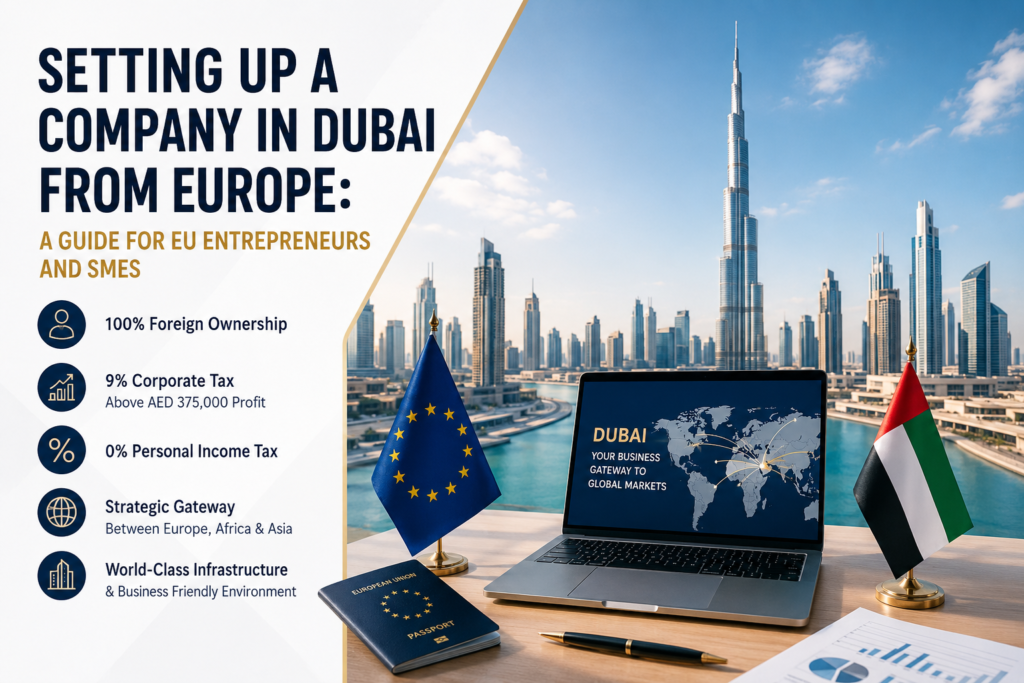
For a founder based in Germany, France, the Netherlands, or another EU member state, the UAE offers something the EU single market cannot: full foreign ownership with no local partner requirement in almost every sector, a 9% corporate tax rate that only applies above AED 375,000 in profit, and zero personal income tax. Combined with the UAE’s position as a genuine trade bridge between Europe, Africa, and Asia, and a business culture where English functions as the default working language even outside English-speaking contexts, it is an increasingly common second base for EU SMEs looking to expand beyond the single market rather than deeper into it.
What is different for an EU founder compared to, say, a UK founder is the tax and regulatory starting point. EU member states each have their own domestic tax residency rules and their own network of double taxation agreements with the UAE, so the specifics of what happens to your home-country tax position depend heavily on which EU country you are resident in, rather than a single unified answer.
One of the biggest advantages of Setting Up a Company in Dubai from Europe is the ability to use Dubai as a strategic international hub while maintaining strong commercial relationships with customers and suppliers across Europe.
Setting Up a Company in Dubai from Europe: Double Taxation Agreements Vary by EU Member State
The UAE has bilateral double taxation agreements with the large majority of EU member states, but the terms, the definition of tax residency, and the treatment of dividends and business profits are not identical across all of them. A founder based in Ireland faces a different practical analysis to one based in Italy or Poland, even though the underlying UAE company structure might be identical.
Before assuming any particular tax outcome, it is worth confirming the specific treaty terms between the UAE and your home country, and how your home country’s tax authority defines corporate residency and management and control, since this is the area with the most variation across the EU.
Anyone considering Setting Up a Company in Dubai from Europe should obtain professional tax advice covering both the UAE and their home country before making major business decisions.
Setting Up a Company in Dubai from Europe: Free Zone versus Mainland for an EU-Based Business
The Free Zone versus Mainland decision follows broadly the same logic for EU founders as for any international entrepreneur: Free Zone suits businesses exporting services or goods from the UAE to international markets, including back into the EU, with full foreign ownership and lower setup costs, while Mainland suits businesses that need to trade directly with UAE-based clients or bid on local government contracts.
For most EU SMEs using Dubai as a regional hub for GCC and Asian expansion rather than a UAE-facing retail or services business, Free Zone is the more common starting structure.
One EU-specific consideration worth flagging: if your EU home company will continue trading with the new UAE entity, for instance supplying goods or services between the two, the cross-border VAT treatment needs proper structuring from the outset. Intra-EU VAT rules do not extend to UAE transactions, and getting this wrong is a common source of unexpected VAT liability for EU founders who assume the UAE company can be treated like an EU branch for tax purposes.
For businesses Setting Up a Company in Dubai from Europe, selecting the correct company structure from the beginning can reduce compliance risks and simplify future expansion into GCC markets.
Setting Up a Company in Dubai from Europe: What EU Business Owners Should Budget For
Free Zone company formation typically starts from around AED 10,000-15,000 for a basic package, with Mainland setup starting somewhat higher due to the physical office requirement. On top of this, budget for visa costs per person (roughly AED 3,500-4,500), Emirates ID and medical testing, and a corporate bank account, which for EU applicants generally requires the same source-of-funds and compliance documentation as any other foreign applicant, though EU passport holders from countries with strong banking relationships with UAE institutions sometimes find the account opening process marginally smoother.
VAT registration in the UAE becomes mandatory once annual turnover exceeds AED 375,000, at a standard rate of 5%, considerably lower than VAT rates across most of the EU, which is itself a meaningful commercial advantage for EU businesses selling internationally through the UAE entity.
When planning Setting Up a Company in Dubai from Europe, founders should budget not only for incorporation costs but also for banking, visas, compliance services, and ongoing regulatory requirements.
Setting Up a Company in Dubai from Europe: Structuring the Parent-Subsidiary Relationship Correctly
Many EU SMEs approach this as opening a subsidiary of their existing EU company rather than starting entirely fresh, which can simplify group accounting and preserve existing client relationships and contracts.
Done correctly, this involves clearly documenting the UAE entity’s own management, decision-making, and substance, since EU tax authorities, much like HMRC in the UK, can look closely at whether a UAE subsidiary has genuine commercial substance or exists primarily to shift profit away from the EU parent company’s home tax jurisdiction.
Getting this structuring right from formation, with both UAE and EU-side advice, avoids problems that are considerably harder to fix retroactively.
For businesses Setting Up a Company in Dubai from Europe, establishing genuine commercial substance is essential for maintaining tax efficiency and complying with international regulations.
Setting Up a Company in Dubai from Europe: Document Attestation – The Step EU Founders Most Often Underestimate
Non-UAE corporate documents, such as a certificate of incorporation, Memorandum of Association, or board resolutions from an EU parent company, generally need notarisation and, in many cases, attestation through both the issuing EU country’s foreign ministry and the UAE embassy before UAE authorities will accept them.
This process can take longer than the actual UAE company registration itself if not started early, and it is one of the most common causes of delay for EU founders who assume their existing EU corporate documents can simply be submitted as-is.
Starting document attestation in parallel with, rather than after, the UAE application process is the single most effective way to avoid this becoming the critical path item that determines how quickly your company is actually operational.
Businesses Setting Up a Company in Dubai from Europe should begin preparing and attesting corporate documents as early as possible to avoid unnecessary registration delays.
Setting Up a Company in Dubai from Europe: Language and Translation Requirements
UAE authorities generally require documents to be submitted in Arabic or English, so EU corporate documents originally issued in German, French, Italian, or another EU language typically require certified translation alongside attestation.
Budgeting for this, both in terms of time and the modest additional cost, avoids it becoming a last-minute surprise once the rest of the application is otherwise ready to submit.
When Setting Up a Company in Dubai from Europe, planning for certified translations alongside document attestation helps ensure the application process runs smoothly from start to finish.
Setting Up a Company in Dubai from Europe: Banking Realities for EU Applicants
EU founders sometimes expect that strong home-country banking relationships, particularly with major pan-European banks, will translate into a smoother UAE account opening experience.
In practice, UAE banks assess each applicant independently against their own compliance standards, and the strength of your EU banking history helps mainly insofar as it provides clean, well-documented evidence of your business’s financial history and source of funds, not as a shortcut around the UAE bank’s own due diligence process.
Preparing this documentation clearly and comprehensively before applying, including audited or management accounts where available, consistently produces faster outcomes than relying on the reputation of your home bank alone.
Entrepreneurs Setting Up a Company in Dubai from Europe should prepare detailed financial records and source-of-funds documentation before approaching UAE banks for account opening.
Setting Up a Company in Dubai from Europe: Using Dubai as a Genuine Regional Hub, Not Just a Tax Address
The EU founders who get the most long-term value from a UAE entity tend to be the ones who use it as a genuine operating base for GCC and Asian expansion, rather than treating it purely as a favourable tax jurisdiction layered onto an otherwise unchanged EU business.
Dubai’s logistics infrastructure, its position within a few hours’ flight of most of the GCC, South Asia, and East Africa, and its deep pool of multilingual talent make it a credible base for building out sales, partnerships, and operations across a region an EU-only business would otherwise find harder to reach.
Approaching the UAE entity this way, with real commercial purpose beyond the tax position, also happens to be exactly the kind of substance that makes the tax treatment more defensible in the first place.
Businesses Setting Up a Company in Dubai from Europe often achieve greater long-term success when they use Dubai as a genuine operational headquarters rather than simply as a tax-efficient jurisdiction.
Setting Up a Company in Dubai from Europe: Frequently Asked Questions
Does the UAE Have a Tax Treaty with Every EU Country?
The UAE has double taxation agreements with the majority of EU member states, but terms differ, so it is worth confirming the specific treaty and its provisions for your home country before finalising your structure.
Anyone Setting Up a Company in Dubai from Europe should verify the applicable tax treaty between their home country and the UAE before making investment or corporate structuring decisions.
Can My EU Company Own the UAE Entity Directly?
Yes, most UAE Free Zones and Mainland jurisdictions permit corporate shareholders, meaning your EU company can hold the UAE subsidiary directly, subject to standard documentation requirements including notarised and, in some cases, attested corporate documents.
Many businesses Setting Up a Company in Dubai from Europe choose a parent-subsidiary structure because it supports international expansion while maintaining continuity with existing European operations.
Is UAE VAT Relevant If I Am Mainly Selling to EU Clients?
It depends on where the supply is deemed to take place under UAE VAT rules; cross-border transactions between the UAE entity and an EU parent or clients need proper VAT structuring to avoid double charging or unexpected liability.
Professional VAT planning is recommended for companies Setting Up a Company in Dubai from Europe to ensure compliance with both UAE tax regulations and European VAT obligations.
How Long Does Setup Take for an EU-Based Applicant?
Similar to other international founders, a straightforward Free Zone setup typically takes four to six weeks from application to an operational company with a bank account, assuming documentation is complete and properly notarised where required.
The overall timeline for Setting Up a Company in Dubai from Europe depends largely on how quickly documentation, banking requirements, and attestation procedures are completed.
Setting Up a Company in Dubai from Europe: Conclusion
Setting Up a Company in Dubai from Europe offers EU entrepreneurs and SMEs an excellent opportunity to expand internationally while benefiting from full foreign ownership, competitive taxation, and access to fast-growing regional markets. Dubai continues to attract European businesses looking for a strategic base connecting Europe, the Middle East, Africa, and Asia.
Success depends not only on choosing the right Free Zone or Mainland structure but also on understanding tax treaties, VAT implications, banking requirements, document attestation, and the importance of establishing genuine commercial substance. Addressing these factors early makes the company formation process smoother and reduces future compliance risks.
By carefully planning every stage of Setting Up a Company in Dubai from Europe, founders can create a well-structured UAE business that supports sustainable international growth while remaining compliant with both UAE regulations and their home country’s legal and tax requirements.