
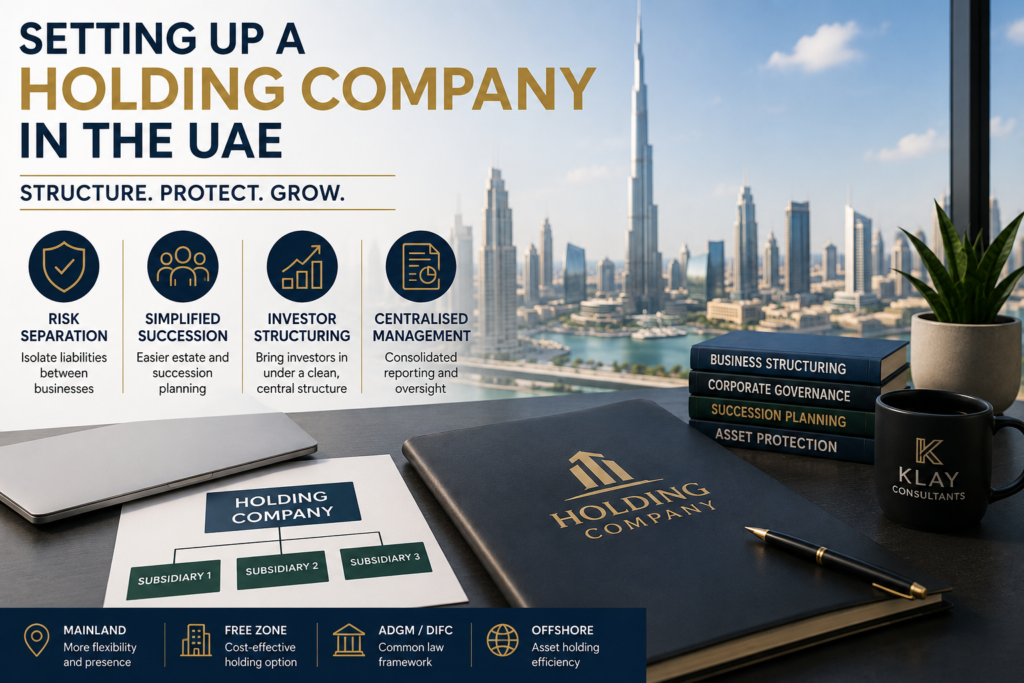
Learn how to set up a UAE holding company, including structure, benefits, jurisdiction options, tax considerations, and how it differs from an offshore entity.
Setting Up a Holding Company in the UAE
UAE holding company setup is becoming an increasingly popular structure for founders and investors who own multiple businesses, investments or other assets. Instead of holding each business interest personally, a UAE holding company can consolidate ownership under a single corporate structure.
As a business grows beyond a single UAE venture, questions around ownership, risk separation, succession and investment structuring become increasingly important. A holding company can provide a practical framework for managing multiple operating businesses while keeping their ownership under one parent entity.
What Is a Holding Company in the UAE?
A holding company is an entity whose primary purpose is to own shares or interests in other companies, commonly referred to as subsidiaries, rather than conducting significant trading operations itself.
In a UAE context, a holding company may own shares in one or more Mainland or Free Zone businesses, or potentially hold interests in international companies depending on the chosen jurisdiction and structure.
The holding entity may have minimal direct commercial activity while providing a central ownership structure for the wider business group.
Why Do Founders Set Up a UAE Holding Company?
There are several reasons founders and investors consider UAE holding company setup when structuring multiple ventures.
Risk Separation
A holding structure can help separate the ownership of different operating businesses. Each subsidiary can maintain its own contracts, liabilities and operations rather than placing every venture under a single operating company.
This can make the overall group structure easier to manage, although the legal protection provided depends on how each entity is structured and operated.
Simplified Succession Planning
Holding multiple business interests through one parent entity can simplify ownership and succession planning. Instead of transferring interests in several operating companies individually, ownership can potentially be consolidated at the holding-company level.
This can be particularly relevant for family businesses planning for a future generational transition.
Cleaner Investor Structuring
A holding company can provide a central structure for investors participating in a group of businesses. Depending on the circumstances, investors may participate at the holding-company level rather than negotiating separate ownership arrangements across several operating entities.
Centralised Management and Reporting
A parent holding company can provide a central point for financial oversight, strategic decision-making and reporting across multiple subsidiaries.
This can be useful for founders who operate several businesses and want a more organised group structure.
Onshore Holding Company vs Offshore Holding Structure
One of the most common questions surrounding UAE holding company setup is whether an onshore or offshore structure is more appropriate.
An onshore UAE holding company, established in a Mainland or Free Zone jurisdiction, can hold shares in subsidiaries and may, depending on the jurisdiction and activity, maintain a physical presence and access certain UAE corporate facilities.
An offshore holding structure, such as one established through RAK ICC or JAFZA Offshore, is generally designed for holding assets or shares without operating a business within the UAE domestic market.
| Factor | Onshore Holding Company | Offshore Holding Structure |
|---|---|---|
| Own subsidiary shares | Yes | Yes, subject to applicable rules |
| UAE operational presence | Possible | Generally not |
| Visa sponsorship | May be available | Generally not available |
| Physical office | Depends on jurisdiction and requirements | Generally not required |
| Operating UAE business | Possible where licensed | Not permitted as a domestic operating business |
| Best suited for | Active business groups | Pure holding and asset structures |
Where Can You Set Up a UAE Holding Company?
The best jurisdiction for UAE holding company setup depends on what the holding company will own, whether it needs an operational presence and how complex the ownership structure is.
Mainland UAE
A Mainland holding company can be suitable where the parent entity needs a physical UAE presence or broader flexibility within the UAE. It can be considered by founders who want the holding structure to sit alongside operating Mainland businesses.
Mainland structures may involve office requirements and other licensing or regulatory considerations, so the total setup cost and requirements should be assessed based on the intended activity and ownership structure.
UAE Free Zones
Several UAE Free Zones offer structures that can be used for holding activities. Free Zone options may be attractive where the holding company does not require the same physical presence as a Mainland entity and the selected jurisdiction permits the intended holding activity.
Requirements vary between Free Zones, including licensing, office arrangements, ownership rules and ongoing compliance obligations.
ADGM and DIFC
Abu Dhabi Global Market (ADGM) and Dubai International Financial Centre (DIFC) are often considered for more sophisticated holding structures, particularly where international investors or complex ownership arrangements are involved.
Both jurisdictions operate within frameworks influenced by common law principles, which can be attractive for international investors who are familiar with common-law corporate structures.
However, these jurisdictions can involve higher establishment and ongoing compliance costs than simpler Free Zone structures, making them more appropriate where their legal and structuring advantages justify the additional cost.
How to Set Up a Holding Company in the UAE
The UAE holding company setup process depends on the selected jurisdiction and the assets or companies that will be held. However, the process generally follows several key stages.
1. Define What the Holding Company Will Own
Start by identifying exactly what the holding company is intended to hold.
- Shares in existing UAE companies.
- Shares in international subsidiaries.
- Real estate interests, where permitted.
- Intellectual property.
- Investment portfolios or other qualifying assets.
The intended assets and ownership structure will influence which jurisdiction and legal structure are most appropriate.
2. Choose the Appropriate UAE Jurisdiction
Once the purpose of the holding company is clear, compare Mainland, Free Zone, ADGM, DIFC or other applicable structures.
Consider factors such as:
- Whether the holding company needs a physical UAE presence.
- Whether visa sponsorship is required.
- The type of subsidiaries being held.
- Whether international investors will participate.
- Expected setup and annual maintenance costs.
- Corporate governance requirements.
- Tax and compliance considerations.
3. Incorporate the Holding Entity
The next stage is to establish the holding company with the selected authority. This generally involves choosing the legal structure, reserving the company name, preparing incorporation documents and completing the relevant licensing requirements.
The exact documentation depends on the shareholders, jurisdiction and nature of the holding activity.
4. Transfer or Register Subsidiary Shareholdings
If the holding company is being created to own existing businesses, the relevant shares or ownership interests may need to be formally transferred to the new parent entity.
This can involve updating shareholder registers, corporate documents and, where required, the Memorandum of Association of the subsidiary companies.
5. Establish the Group Governance Structure
After the holding company and subsidiaries are correctly structured, establish clear governance and reporting arrangements.
This may include defining:
- Board composition.
- Shareholder decision-making rights.
- Reporting responsibilities.
- Financial oversight.
- Approval procedures for major transactions.
- Relationship between the parent company and subsidiaries.
Tax and Compliance Considerations for UAE Holding Companies
Tax and regulatory planning should form part of the UAE holding company setup process from the beginning. The tax treatment can depend on the activities of the holding entity, the assets it owns, the jurisdiction selected and the wider ownership structure.
Economic Substance Considerations
Holding-company activities can have specific regulatory implications. Businesses should determine whether any applicable Economic Substance Regulations or other reporting requirements apply to their particular structure and activities.
Notification and compliance requirements should be reviewed based on the company’s actual activities rather than simply relying on the name of the license.
Corporate Tax Considerations
UAE Corporate Tax treatment can vary depending on the nature of income received by the holding company and the applicable conditions. Dividends, capital gains and income from subsidiaries may receive specific treatment where the relevant requirements are satisfied.
Because group structures can involve multiple entities and jurisdictions, professional tax advice is recommended before transferring significant shareholdings or assets into a UAE holding company.
Common Uses of a UAE Holding Company
Multiple Operating Businesses
A founder operating several separate businesses can use a holding structure to consolidate ownership while keeping each operating company legally distinct.
Family Business Succession
Family businesses may use a holding company to consolidate ownership before a planned generational transition, potentially making future ownership arrangements easier to manage.
International Investment Structures
International investors may use UAE holding structures to consolidate qualifying UAE and international investments under one corporate entity, subject to applicable legal and tax rules.
Preparing for External Investment
A holding structure can also be considered where a founder expects to raise external capital. Depending on the circumstances, issuing equity at the holding-company level can provide a central ownership structure for multiple operating businesses.
Common Mistakes to Avoid When Setting Up a UAE Holding Company
Choosing an Offshore Structure When an Onshore Structure Is Needed
One of the most common mistakes is selecting an offshore holding structure when the parent company actually needs a UAE operational presence, office or visa sponsorship. Offshore entities are generally designed for holding and international structuring rather than operating a business within the UAE domestic market.
Ignoring Economic Substance and Compliance Requirements
Founders should review the compliance obligations associated with their specific holding activities. Assuming that a holding company has no compliance requirements simply because it does not conduct day-to-day trading can create unnecessary regulatory problems.
Failing to Update Subsidiary Ownership Records
When existing businesses are transferred under a new holding company, the ownership change should be formally documented. This may involve updating subsidiary shareholder records, constitutional documents and relevant authority records.
Underestimating Tax and Cross-Border Complexity
Holding structures involving companies, shareholders or assets across multiple countries can create additional tax and reporting considerations. Founders should review the structure before transferring significant assets or shares rather than treating tax planning as a later step.
Choosing a Jurisdiction Based Only on Cost
The cheapest incorporation option is not necessarily the most appropriate holding structure. Governance requirements, investor expectations, banking, office requirements, tax considerations and future expansion should all be considered before selecting a jurisdiction.
Frequently Asked Questions About UAE Holding Company Setup
Can a UAE holding company own shares in companies outside the UAE?
Generally, yes, depending on the selected jurisdiction, legal structure and applicable laws. Many holding structures are designed to consolidate UAE and international shareholdings under one parent entity.
Does a UAE holding company need its own office?
This depends on the jurisdiction and structure. Some Free Zone holding structures may operate with flexible office arrangements, while Mainland structures can have physical office requirements. ADGM and DIFC have their own specific substance and office requirements.
Can a UAE holding company sponsor visas?
An onshore holding company may be able to support UAE residency and visa arrangements where its jurisdiction and license permit this. Offshore entities generally do not provide UAE residency visas through the offshore structure itself.
Is a holding company the same as an offshore company?
No. A holding company describes the purpose of an entity that owns shares or assets. It can be established through an onshore Mainland or Free Zone structure or, in certain circumstances, through an offshore structure. An offshore company is a specific type of UAE entity with restrictions on domestic UAE operations.
Can a holding company own multiple UAE businesses?
Yes, subject to the applicable legal and regulatory requirements. A holding company can potentially own shares in multiple subsidiaries, allowing different operating businesses to remain separate while being controlled under a common ownership structure.
Can a holding company own intellectual property?
Depending on the jurisdiction and structure, a holding company may be able to hold intellectual property or interests in intellectual property. The legal ownership, licensing arrangements and tax treatment should be reviewed before transferring valuable IP.
Is a UAE holding company suitable for a family business?
It can be. A holding structure can consolidate ownership of multiple businesses and may support longer-term succession planning. However, the structure should be designed alongside appropriate wills, foundations or other succession arrangements where required.
UAE Holding Company Setup: Choosing the Right Structure
The right UAE holding company setup depends on the purpose of the parent company and what it is intended to own.
A simple Free Zone structure may be appropriate for a founder looking for a cost-effective parent company for several operating businesses. A Mainland structure may be more suitable where the parent company needs a physical UAE presence or broader local functionality.
For international investors, sophisticated shareholder arrangements or structures requiring a common-law framework, ADGM or DIFC may provide advantages that justify their additional costs and governance requirements.
There is no single holding-company structure that is appropriate for every founder. The best option depends on the number of subsidiaries, asset types, investor requirements, residency needs and long-term succession objectives.
Benefits of a Properly Structured UAE Holding Company
- Centralised ownership of multiple businesses.
- Potential separation of operating-business risks.
- Simplified group-level governance.
- More organised succession planning.
- Flexible investment and shareholder structuring.
- Potential consolidation of UAE and international interests.
- A clearer framework for future business expansion.
However, a holding company should not be created solely for perceived tax advantages. The structure needs to have a genuine commercial and legal purpose and should comply with all applicable UAE and international requirements.
Final Thoughts on UAE Holding Company Setup
UAE holding company setup can provide founders and investors with a structured way to manage multiple businesses, investments and ownership interests under a central corporate entity.
The structure can be particularly useful for entrepreneurs who operate several ventures, family businesses preparing for succession and investors building a portfolio of UAE or international companies.
The most important decision is choosing a structure that matches the actual purpose of the holding company. Mainland, Free Zone, ADGM, DIFC and offshore options have different requirements, costs and capabilities.
Before incorporating, founders should consider ownership, subsidiary shareholdings, office requirements, visa needs, tax treatment, compliance obligations and long-term business objectives.
Set Up a UAE Holding Company with Klay Consultants
Klay Consultants helps founders and investors evaluate and structure UAE holding company setup based on their business interests, subsidiaries, investment objectives and long-term plans.
Our team can help assess suitable jurisdictions, coordinate company formation and structure the ownership of multiple UAE ventures while considering operational, tax and compliance requirements.
Whether you are consolidating existing businesses, preparing for investment or planning succession for a family business, choosing the right holding structure at the beginning can make future administration significantly easier.
Managing multiple UAE ventures? Book a consultation with Klay Consultants to review your holding-company structure and identify the most suitable UAE setup for your business.