
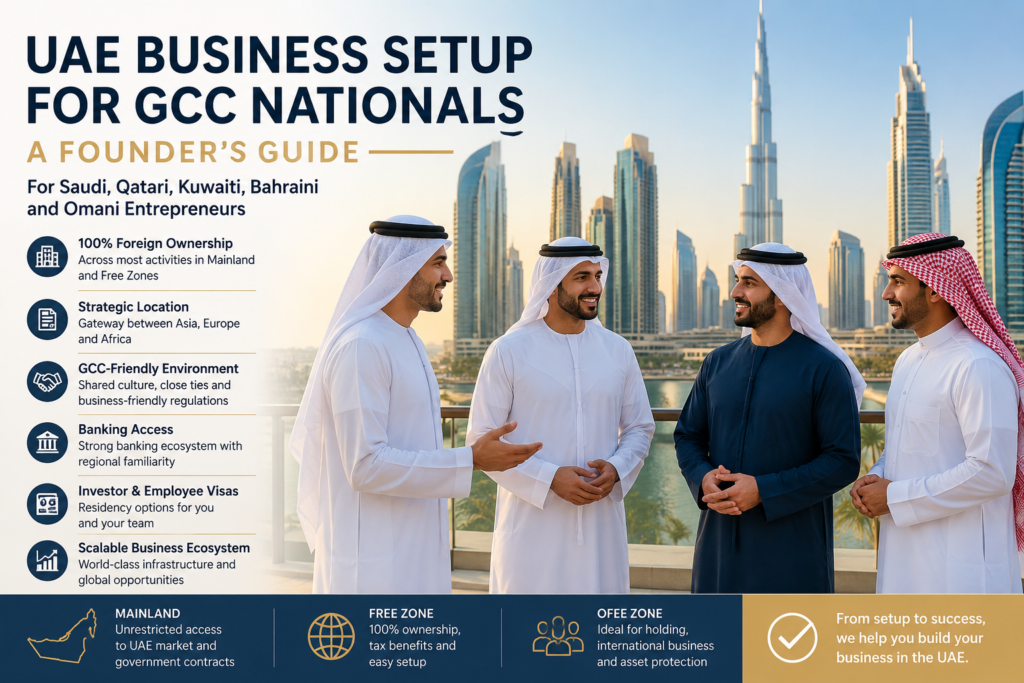
UAE Business Setup for GCC Nationals: A Founder’s Guide for Saudi, Qatari, Kuwaiti and Bahraini Entrepreneurs
For entrepreneurs based in Saudi Arabia, Qatar, Kuwait, Bahrain, and Oman, expanding into the UAE is often the natural next step rather than entering an entirely foreign market. Shared language, cultural familiarity, close geographical proximity, and strong economic ties make Dubai and Abu Dhabi ideal destinations for businesses looking to scale across the Gulf region. However, UAE business setup for GCC nationals still requires careful planning, as selecting the right business structure, jurisdiction, and licensing model has a significant impact on future growth.
Why GCC Entrepreneurs Expand into the UAE
The UAE has established itself as one of the region’s leading business hubs, offering access to international investors, global financial institutions, advanced infrastructure, and customers across Europe, Asia, and Africa. Many GCC companies establish UAE operations to strengthen their regional presence while benefiting from the country’s efficient regulatory environment and internationally recognised business ecosystem.
For many founders, the UAE serves not only as a second market but also as a regional headquarters supporting expansion into multiple international markets.
Do GCC Nationals Receive Different Treatment?
GCC nationals benefit from regional economic cooperation agreements that can simplify certain administrative procedures compared with founders from outside the Gulf region. Documentation requirements, identity verification, and cross-border business recognition are often more familiar due to the close integration between GCC member states.
However, company formation regulations still apply. Entrepreneurs must choose the correct business activity, obtain the appropriate licence, meet compliance obligations, and satisfy regulatory requirements regardless of nationality.
Choosing Between Mainland and Free Zone
One of the most important decisions during UAE business setup for GCC nationals is selecting the right jurisdiction.
Businesses planning to serve customers directly within the UAE often choose a Mainland licence. This structure is suitable for retail businesses, professional services, construction companies, restaurants, healthcare providers, and businesses targeting government contracts.
Free Zone companies remain popular among consultants, technology firms, digital agencies, exporters, e-commerce businesses, and international service providers. They offer faster incorporation, simplified administration, flexible office options, and competitive setup costs.
The right choice depends entirely on your business model, customer base, and long-term expansion strategy rather than simply choosing the lowest-cost option.
Banking Considerations
Opening a corporate bank account remains one of the most important stages of company formation. Although many GCC entrepreneurs already bank with regional financial institutions, UAE banks perform independent Know Your Customer (KYC) and compliance reviews for every corporate application.
Banks generally require:
- Shareholder identification documents
- Source of funds evidence
- Business plans
- Expected transaction volumes
- Information about suppliers and customers
Preparing complete documentation before applying helps reduce delays and improves the likelihood of faster account approval.
Visa Requirements
While GCC nationals enjoy easier travel across the region, operating a UAE company often involves additional immigration considerations, particularly when employing staff or acting as the resident manager of the business.
Investor visas and employee visas remain important depending on the chosen business structure and operational requirements. Planning visa needs during company formation helps avoid unnecessary amendments later.
Step-by-Step UAE Business Setup for GCC Nationals
1. Define Your Business Goals
Determine whether your UAE company will serve local customers, international clients, or act as a regional headquarters.
2. Select Your Business Activity
Choose activities that accurately reflect your planned operations to avoid licensing or banking complications later.
3. Choose Mainland or Free Zone
Select the jurisdiction that best matches your target market, operational requirements, and future expansion plans.
4. Prepare Documentation
Gather identification documents along with any existing company records if expanding an established GCC business into the UAE.
5. Apply for Your Business Licence
Submit the application to the relevant authority. Most straightforward applications are processed within a few working days once documentation is complete.
6. Open Your Corporate Bank Account
Complete the required compliance checks and banking procedures before commencing operations.
Common Mistakes to Avoid
Many GCC entrepreneurs assume business procedures are identical across the Gulf. In reality, UAE regulations differ from those of Saudi Arabia, Qatar, Kuwait, Bahrain, and Oman.
Common mistakes include:
- Choosing a licence based only on cost
- Selecting incorrect business activities
- Underestimating banking documentation requirements
- Ignoring visa planning
- Delaying tax and compliance registrations
Working with experienced advisors helps minimise delays and ensures the business is structured correctly from the beginning.
Frequently Asked Questions
Is company formation faster for GCC nationals?
The overall licensing timeline is generally similar for all founders. However, GCC nationals may experience smoother documentation and identity verification due to regional familiarity.
Can an existing GCC company open a UAE branch?
Yes, branch registration is possible in certain situations. Whether a branch or a new UAE subsidiary is more suitable depends on your business activities, liability considerations, and long-term expansion strategy.
Which structure is best for GCC entrepreneurs?
There is no universal answer. Businesses targeting the UAE domestic market often benefit from Mainland licensing, while companies focused on international trade or regional services frequently choose Free Zone structures.
Final Thoughts
The UAE continues to be one of the strongest destinations for Gulf entrepreneurs seeking regional and international growth. With the right business structure, licensing strategy, banking preparation, and compliance planning, UAE business setup for GCC nationals can provide a strong platform for long-term expansion across the Middle East and beyond. Choosing the appropriate structure from the outset allows businesses to scale more efficiently while avoiding unnecessary restructuring costs in the future.